

I, King (insert African Monarch) with the consent of my council, grant and transfer my entire rights to the country to (insert European Monarch or company) …
Just like that? Above is an excerpt of the treaty signed by Sultan Umar of the Sokoto Caliphate in 1885. We shall come back to it later.
One thing that strikes me as interesting in studying West African history is the similarities in the time arc of different civilisations especially the latter phases. You have these kingdoms that have been established in response to some adversity, have survived and evolved through conquest and trade and have become relatively stable powers. Then comes a phase of increasing contact with European nations and just like a lot of new relationships, it’s nice at first, like a sweet honeymoon glow but it almost always ended in conflict.
These conflicts were usually preceded by an agreement of sorts – a treaty which spelled out the kind of relationship between the African and European nations involved.
I have read through a few of them and I’m shocked as to why anyone would agree to such unequal terms , even the famous Lord Lugard who brokered or enforced several treaties on behalf of the British once said ”treaties were utter frauds , no man if he understood would sign it”.
As with most agreements, there are expectations from both sides , then there is the real intent buried in the fine print and sometimes it was quite plain to see.
Turns out that the matter was often a foregone conclusion, and the treaty was required as little more than ‘’evidence’’ by foreign powers in dealing with other foreign powers.
For some context, we’d look at it from both sides.

At the end of the 19th century Europe had already undergone significant societal transformations. There were new powers and new nation states had replaced the old feudalistic systems. Slave trade and slavery had been abolished and the industrial revolution was in full swing.
This was the height of exploration. The African continent had always been known to Europe, but never really explored beyond the coast, mostly because they never needed to, and it was probably too dangerous for them to do so.
Goods and slaves would be transported to the coast for them by Africans (I’ll be doing a post on this soon – why Africans sold one another into slavery). Moreover, tropical diseases especially malaria made the interior of Sub-Saharan Africa the ‘’white man’s grave ‘’.
This was soon to change from the 1850s when quinine began to be massed produced, meaning a freely available ‘’odeshi’’ for malaria could be accessed. At the same time, other non-human commodities began to see an increase in demand like palm oil and rubber.
Besides the allure of Africa’s considerable endowment with raw materials, European nations needed to access the African hinterland to secure legitimate trade and shipping routes, have annexes for military bases and have colonial territories to bargain with – as diplomatic chess pieces. There was also the issue of national pride – foreign territories were kind of the in thing those days. One had to look the part, after all.
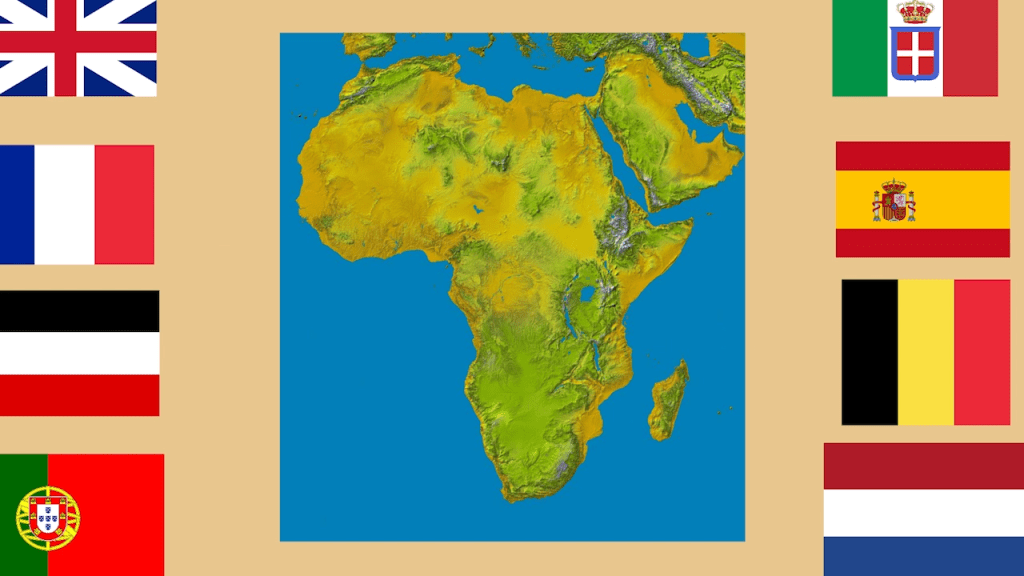
Thus, wealthy individuals, companies and countries were sponsoring exploration trips to the land of the sun to check out its vast and untapped potential. Soon, what started out as a curious trickle beyond the coastlines escalated to an all-out scramble.
Now, the preceding centuries in Europe had seen a series of wars – War of Austrian succession, 7 years’ war (which started out as an overseas battle between colonies), the Napoleonic wars, and more recently the Franco- Prussian wars – to name a few.
Europe was war weary; war was bad for the economy and life in general. So, to avoid unnecessary conflict between the world powers over territories in Africa, 14 nations (Germany, France, Italy, Belgium, Britain, Denmark, Spain, USA, Russia, Portugal, Austria-Hungary, Sweden -Norway and the Ottoman Empire) all met in Berlin at a conference 1884 -1885.

Here, they set up rules determining how to mark out their spheres of influence on the African continent. Basically, they made it impossible to claim any territory without actually having a presence there, one could not simply sit in Brussels for instance and claim land in say Gambia just because an explorer had mapped it out. Any power wanting to carve a piece of the African soil had to effectively occupy said territory. This meant they must have evidence of trade agreements or treaties of protection with the native kingdoms and have an administrative set up on ground like a consulate or residency office to govern the areas claimed and if necessary, by force.
So where does this leave the Native African kingdoms and what role did treaties play in all this? Well, treaties had been around way before the Berlin conference, but they began to truly ramp up in this period. The British via consuls or companies signed treaties with Asaba – 1884, Sokoto -1885 (revised in 1890), Opobo -1884, to name a few; all offering protection and friendship in exchange for
– sole trade and correspondence with all Europeans to be conducted through them,
– oversight over foreigners in this region,
– protection of missionaries and all Europeans,
– Assisting British appointed consuls in discharging their duties
– There was ceding of sovereignty in some cases
– and local rulers were often paid considerable pensions.
It seems foolhardy that any sovereign would be so short sighted as to surrender sovereignty for a yearly pension, but it is a bit more complex than that.
These treaties, they were often written in English (in the context of Nigeria) and though they had to be translated and explained, the translators often had to be tactical, towing a difficult line between a powerful foreign employer and a native King, often considered semi divine and definitely authoritarian. One translator confessed he did not understand that ceding sovereignty meant surrendering independence and that even if he did, he dared not mention it to his King as it was too outrageous.
The wordings were often very loose and fraught with traps.
In the treaty with Opobo for instance, a portion reads: ‘’Her majesty the queen etc, in compliance with the request of the kings and people of Opobo hereby undertakes to extend to them (Opobo) and to territory under their authority and jurisdiction, her gracious favours and protection’’ – On the condition that Opobo could not enter any correspondence, agreement, or treaty with any other foreign nation without the knowledge and sanction of Great Britain.
Jaja, king of Opobo smelled a rat and had to ask what was meant by protection. We all know how that story eventually ended (he was deposed an exiled when judged to obstruct free trade in contradiction to the terms and spirit of the Berlin agreement which no African nation was present at).

In the case of Sokoto, there were 2 different treaties and there was some confusion, especially with later Sultans, between the first and second treaties.
In the first, Umar, Sultan of Sokoto, with the consent of his council ‘’ grants and transfers to the National African Company LTD or their representatives, his entire rights of his country on both sides of the rivers Niger and Benue ‘’…further rights granted to the NAC included sole right among foreigners to trade, and the right to channel all foreign correspondences through them. Theses rights were irrevocable and signed to continue in perpetuity. In return, Sultan Umar was to get a yearly present to a value of 3000 cowries
The second treaty in 1890 secured to foreigners the protection of European government and the rights of the Royal Niger Company to exercise jurisdiction over Europeans and levying taxes. He further ratified the previous treaty from 1885.
As part of his explanation for such shocking terms, Sultan Umar acknowledged that to secure the wealth, prosperity and security of his realm, he had to trade with Europeans, and this would not be possible without securing the protection of Europeans in his domain to European governments. He needed arms with which to prosecute wars to secure the vast frontiers of the massive Sokoto empire as well as put down rebellions.
Moreover, news about the military prowess and conquests of Britain and France had been filtering in from India, Sudan, and Egypt for decades so he knew he had to tread with caution.
The confusion about the ‘’rights’’ granted from the 1885 treaty surfaced in 1900s when the British Lord Lugard declared a protectorate over the emirates of the Sokoto caliphate. The reigning Sultan at the time – Attahiru was livid, he had understood the yearly payments made to him to be that of a vassal paying an overlord rather that a pension paid in return for ceding sovereignty. So, he became hostile and the British called foul. In the conflict that followed, Sultan Attahiru was eventually defeated – watch his famous last stand in Burmi here.
Even when the terms of treaties were fully understood, co -operation from African rulers was encouraged through inducements in the form of money, weapons and promise of protection from rivals and if that did not work, they were coerced into signing by military force or threat of one.
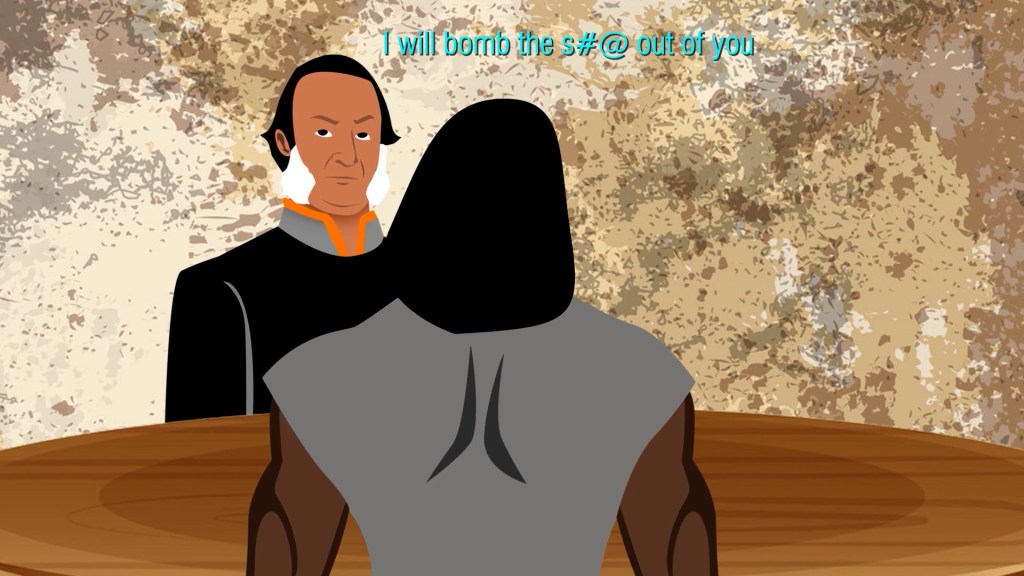
In Lagos in 1861, due to continued slave trading by certain factions in Lagos (Madam Tinubu and co), the British ‘’with some reluctance’’ decided on the full occupation, take over and administration of Lagos as a crown dependency.
King Dosunmu and his advisors were informed about this in June 1861, they initially declined, so the HMS Prometheus moved within gunshot of the city and the rulership of Lagos were informed that an answer was needed by 6th of August otherwise ‘’formal possession’’ of the town would commence.
Of course, they all remembered the battle of boiling canons from 10 years before where Britain and her Ships from The West African Squadron had backed one side of the Lagos royal family (Akitoye) in a civil war against Kosoko – it was a great spectacle.
On the 6th of August 1861, King Dosunmu and 4 of the main chiefs of Lagos signed a treaty of cession in the British Consulate. You can watch the battle of boiling cannons and the fallout of that here.
So African kingdoms signed these treaties for trade, for securing friendship with powerful foreign nations, for protection from other foreign nations and local rivals.
Some signed to retain some form of autonomy as Akitoye king of Lagos had done in 1851 whilst ousting a rival.
But most signed because the handwriting was clear. The result was inevitable anyways, the challenging powers were much to powerful to resist, might as well make the transition as bearable for everyone involved …and maybe secure some personal concessions for yourself and your family whilst at it.
For the European powers, it wasn’t that deep. These treaties weren’t so much about protection as they were about control. Beyond constituting agreements between two sovereign nations, the real intent of any treaty was to stand as proof to other European powers that they had effectively occupied said lands. A proof of address or residence that could be tendered during negotiations with other European powers. That was the value , on their part , of the paper shield: it was a proof of occupation or intent thereof.
 Akwilani History
Interesting read.
LikeLike
Thank you I’m glad you liked it
LikeLike